
I imagine infinities prior.
The galaxies have always just
existed.
Steady State.
No beginning.
No end.
Thirteen point eight billion years ago.
I feel a wave of heat pierce my skin, like a breath of fire,
fleeting and sharp in its encounter.
The rush of a million hot, oozing particles—
flying like comets through the air.
Expanding,
cooling,
from the first central point.
BANG.
Silenced by the hush of space,
my curiosity whispers:
There must be more,
there must be more.
I see a massive star,
erupting in gas and light,
glowing in red hue.
Its shape looks familiar—
my eyes widen.
In symmetry with the star’s center,
lies the iris of the eye.
How gentle the correspondence.
I think of the seashells,
rescued from the frostbitten waters
of the familiar Boston
coast. Resting in a small, glass jar.
Its spirals appear familiar —
my body stills.
In symmetry with the seashell’s sequence,
lies the double helix structure of DNA.
Spiraling with astounding precision.
How intricate the correspondence.
A macrocosm of the universe within the microcosm of the body.
A masterpiece—
every detail hinting at an origin.
Every ventricle,
artery,
and vein,
perfectly crafted.
Outlined to ensure the heart’s rhythmic installations.
A constant
pulse,
an internal metronome.
Ensuring we can beat—
lub dub, lub dub, lub dub…
Along with music,
guitar strings hum,
cochlear hair cells dance in response,
Wanting to feel the song,
too.
Along with language,
the auditory cortex glows,
firing as the senses converse,
eagerly awaiting
the synaptic connection,
too.
And what do I do?
I lay in wonder and awe.
In humility,
In curiosity,
Learning to understand my place
in this creation,
too.
We seem to think we’ve discovered it all.
The perfect intricacies of this world.
Casting them aside
as luck,
accidental,
or coincidental.
I feel the glow of the sun rest against my skin,
It is not piercing,
It is not fiery.
My mind,
At peace.
The language of Creation stretches,
so expansive.
Ineffable;
the mind falters at the thought of understanding.
Forced to rely on theory and law,
only temporarily hushing the quiet groanings of the soul.
And so,
I wonder—
Is Creation simply by chance or fate?
or the work of a Creator,
perfect in their design?
Thinking, how foolish can we be?
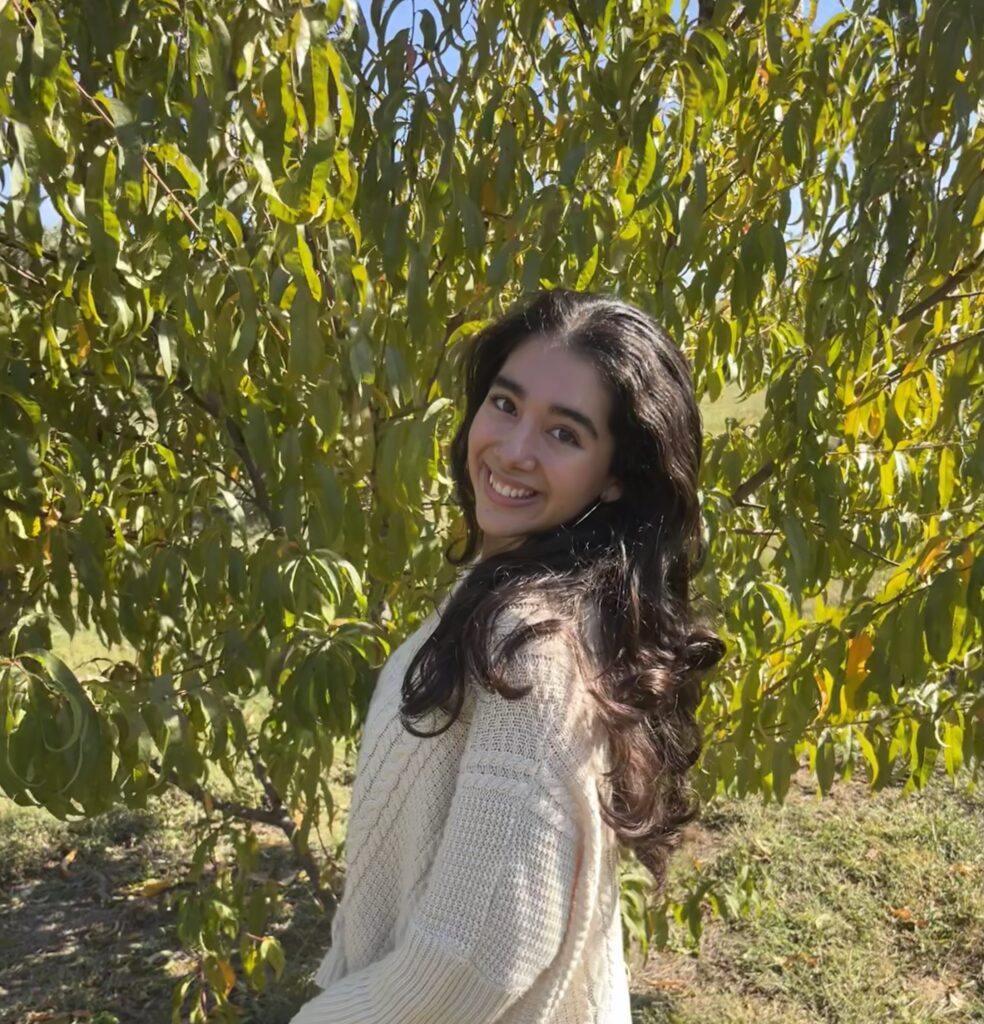
By Sofia Stenson, Contributor
Medicine, Health and Society major, English and Biology minors. Sophomore – Class of 2028, Dallas, Texas. Random facts: I have 5 brothers & I enjoy writing about the intersection between religion and science with poetry as the vessel for its discourse!
References
- Blumenrath, Sandra. “How Hearing Works.” BrainFacts.Org, 10 Jan. 2020, www.brainfacts.org/thinking-sensing-and-behaving/hearing/2020/how-hearing-works-011020.
- Colossians 1:16, Bible, ESV.
- Dixon, Thomas, and Adam R. Shapiro. Science and Religion: A Very Short Introduction. Oxford University Press, 2022.
- Ernst, Henry. “The Stars Have Eyes. How One of Astronomy’s Greatest Images… | by A. Henry Ernst | the Quantum Surfer | Medium.” Medium, 16 May 2018, medium.com/the-quantum-surfer/the-stars-have-eyes-f3065d2fe43b.
- Exodus 15:11, Bible, ESV.
- “Flight to AG Carinae – NASA Science.” Edited by Leah Hustak et al., NASA Hubble Space Telescope, NASA, 17 Aug. 2025, science.nasa.gov/asset/hubble/flight-to-ag-carinae/.
- George, Robbie. “The Living Code: Fibonacci, Polarity & Nature’s True Rhythm.” Robbie George Photography, www.robbiegeorgephotography.com/blog/blog_posts/the-living-code-fibonacci-polarity-fractals. Accessed 28 Jan. 2026.
- Hebrews 11:3, Bible, ESV.
- “How Do We Hear?” National Institute of Deafness and Other Communication Disorders, U.S. Department of Health and Human Services, 16 Mar. 2022, www.nidcd.nih.gov/health/how-do-we-hear.
- James 4:6, Bible, ESV.
- Langley. “Seeing Nature’s Beauty in Numbers.” Flea Market Gardening, 2026, fleamarketgardening.org/2011/12/01/seeing-beauty-in-numbers/.
- Luke 5:26, Bible, ESV.
- May, Andrew, and Daisy Dobrijevic. “What Is the Big Bang Theory?” Space, Space, 29 Jan. 2025, www.space.com/25126-big-bang-theory.html.
- Meisner, Gary. “DNA Spiral as a Golden Section.” The Golden Ratio: Phi, 1.618, 27 Sept. 2020, www.goldennumber.net/dna/.
- professional, Cleveland Clinic medical. “What Is the Iris of the Eye?” Cleveland Clinic, 14 Jan. 2026, my.clevelandclinic.org/health/body/22502-iris.
- Psalm 8:3-4, Bible, ESV.
- Psalm 33:8, Bible, NASB.
- Sounds, Passion For. “Heartbeat from 60 Bpm to 210 Bpm and Slowing down to 45 Bpm.” YouTube, YouTube, www.youtube.com/watch?v=fVK-LP3ecNU. Accessed 29 Jan. 2026.
- “Steady-State Theory.” BYJUS, BYJU’S, 17 May 2022, byjus.com/physics/steady-state-theory/.
- Tapia, Fernando Cordova. “Dancing Hair Cell (Ear).” YouTube, YouTube, 2008, www.youtube.com/watch?v=Xo9bwQuYrRo.
- Ultimate Nature Video Collection: Download 4K, 1080p & Copyright-Free Footage – Pixabay, pixabay.com/videos/search/nature/. Accessed 29 Jan. 2026.
- Ultimate Nature Video Collection: Download 4K, 1080p & Copyright-Free Footage – Pixabay, pixabay.com/videos/search/nature/. Accessed 29 Jan. 2026.United, Hillsong. “Oceans (Where Feet May Fail) – Hillsong United | Instrumental Worship | Fundo Musical.” YouTube, YouTube, www.youtube.com/watch?v=H9U9E3c0Qzg&list=RDH9U9E3c0Qzg&start_radio=1. Accessed 28 Jan. 2026